Some people leave footprints on our heart. Cats leave fur on our sweaters. Dogs leave drool on our shoes. Families will crap on our doorstep. So when life gives you crap, garden it and make roses.
Monday, May 11, 2015
Whistling 'Mack the Knife'
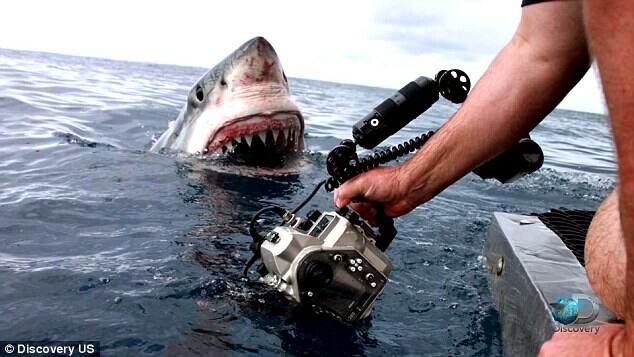
This shark is 4.5 metres long and it has teeth not to mention just a bit of blood smearing from the last kill.
If I had been the photographer washing the camera in the water, the second photo would have been taken from far up in space.
The female shark popped up to have a look around in the ocean off Port Lincoln in South Australia.
Dave Riggs was making a video for Discovery's Shark Week and said he was euphoric to be so close to the animal and thought it was a perfect illustration as to why we need to preserve it as the last living relic of a bygone era.
Riggs also said the shark was researching the area the only way she know how, with her mouth, giving us a nice view of those sharp teeth.
Not so lucky as Dave Riggs was Frenchman Yves Berthelot, holidaying in New Caledonia, whose meeting with a 3.5 metre bull shark was a much more aggressive show. Despite being given first aid aboard his boat, nothing could be done for Mr. Berthelot.
I hope no-one raced out and decided to shoot every shark in the area as frequently happens in Australia. After all it is their home and hunting ground, we're just visiting.
Saturday, April 04, 2015
Ocean cute
Another cute (almost) photo and this is the banded piglet squid (Helicocranchia pferreri). Its name comes from its rotund shape and normally it's found more than 320 feet or 100 metres below the surface of the ocean.
Measuring just 3.9cm in length, this squid species has a singular light producing organ (photophore) to help it navigate the depths.
Because of its deep water habitat little is known of its behaviour but it is known to be a sluggish swimmer with ammonium ions in its body fluid to help keep it bouyant and in this photo it's swimming upside down. Look at the frilly frippy of its little back fins, sweet.
The image was taken from a remotely operated vehicle (ROV) in the Gulf of Guinea near oil pumping equipment at a depth of 1015 metres.
They like tropical and subtropical oceans also the north temperate waters of the Atlantic Ocean with the smaller squid staying higher in the water table and descending into deeper water as they get larger and older.
Sunday, February 10, 2013
That holiday I used to dream of.
Saturday, December 29, 2012
Dip your toes in this water.
The Mid-Cayman Rise is part of the mid-ocean ridge mountain chain where volcanic eruptions creates new oceanic crust that pushes tectonic plates apart but scientists theorize that along some slow-spreading ridges the sea floor becomes unusually thin. That allows water to percolate down to rocks heated by volcanism below. The water picks up chemicals from the rocks and re-circulate and vent at the sea floor.
One of the deepest sites, the Piccard vent field (3.1 miles deep) has fluids gushing from the vents at a temperature just above 400 degrees C (750dF) which are amongst the hottest vents known but different mineral compositions of the seafloor here produce many kinds of vents. This area displays the broadest range of geological processes all active in a small area of seafloor. After the vents had been mapped the researchers used two devices to collect samples.
The SUPR (SUspended Particulate Rosette) sampler is designed to gather dissolved and particulate samples from warm water plumes rising from the vents. The analyzed samples provide chemical, microbial and mineral composition of the plumes and what effects they have on the surrounding ocean water.
Also used are isobaric gas-tight samplers which collect high-temperature vent fluids and maintain them at the high pressure of the deep sea when they come to the surface. They prevent compounds such as methane and hydrogen sulfide, which are liquid at high pressure from becoming gases as the sample is brought to the surface. The idea is to capture gasses before they can interract with the sea water.
Tubeworms are usually found at hydrothermal vents in the Pacific Ocean and at cold seeps in the Atlantic, whereas shrimps dominate hydrothermal sites on the Mid-Atlantic Ridge.
Biologists now have to answer how both animals came together.
'Jason' also used its manipulator arm and vacuumed up snails, anemones, starfish,crabs, fish, shrimp, and tubeworms.
Wednesday, June 13, 2012
What was that famous line about removing a priest?
![]() |
"Obviously you've got to make sure that there are appropriate safeguards taken, but look I think it's very important that we do expand, appropriately, coal mining in Queensland.
"We can't let a green veto stop these projects which are vital for our future prosperity."
Mr. Abbott said this about The Great Barrier Reef. We should all listen to him because he is in Parliament and wants to be Prime Minister. And if this is what he thinks as Opposition Leader, imagine what His Creepiness will do if he ever gets his jaws into real power.
The reef contains:
1,500 species of fish
411 types of hard coral
one-third of the world’s soft corals
134 species of sharks and rays
six of the world’s seven species of threatened marine turtles
more than 30 species of marine mammals, including the vulnerable dugong.
The Royal Navy used to keelhaul miscreants, that is tie rope around them and haul them along the barnacle encrusted hull of the ship and so removing most of the skin and flesh. So let's put a modern spin on this tried and trusted punishment. We hang Mr. Opposition by his feet from a small plane and reef haul him the entire length, making sure we take appropriate safeguards for the reef. I mean those ears alone could wipe out several miles of precious coral.
Yes, I am in a filthy mood and yes, I detest this man.
Tuesday, May 15, 2012
Our big blue Earth.
That blue spot is made up of all the water and is about 700 kms in radius, less than half the radius of our moon. It doesn't show water that may be trapped beneath the surface and research is still in progress to find out how this much water came to be on Earth in the first place.
Spooky!
Monday, April 16, 2012
Titanic still sails.
In 1985 Bob Ballard's idea of live video images from the depths to a surface vessel was a revolution. The scientists could make real-time decisions on where to go in the ship but it still only had black and white video. Then humans went down in the submersible Alvin with high quality colour video cameras and a small ROV called Jason Jnr to penetrate into areas to small for Alvin.
These are photomosaics of Titanic from 2012 and 1987 and shows that the bow has remained relatively intact compared with the stern. The top mosaic consists of approximately 1,500 high-resolution still images shot in 2010, revealing structural changes that have occurred to the bow section.
The bottom image was the first complete image of Titanic on the seafloor and is made up of 100 images pieced together from the 53,000 taken by a towed camera sled. It took approximately 700 hours to make.
(copyright 2012RMS Titanic, Inc.)
There have been many Titanic visits made into documentaries but not enough was done on the position of the images in relation to the ship and the debris scattered on the seafloor. The hope was to detect a pattern in the placement of large sections of the ship indicating how it disintegrated as it sank. Bob Ballard proposed that as Titanic sank, the denser objects would fall more quickly and the less dense objects would fall more slowly and get separated over time by ocean currents to form a trail of debris. But later viewings showed that there were multiple debris fields that didn't fit that proposal.
The aft end of Titanic's keel is deeply embedded in thick, clay-like sediment and the port propeller is also visible in this view. (copyright 2012 RMS Titanic, Inc.)
William Lange felt that pieces of the wreckage were still not giving us the complete story. When in 2009, RMS Titanic Inc., the company which holds the salvage rights, was ready to return to Titanic, he went along to survey the site in an archaeological manner. The team developed scientific protocols including using REMUS vehicles which are not connected to the surface by cables and could be pre-programmed to map the seafloor with sonar devices. They also used a salvage ROV to collect high-resolution optical imagery. This enabled the team to see the wreck in 3-D, a time shot of Titanic as it was in 2010 and will be compared to other expeditions in the future as this voyage is compared to 1985.
According to Lange, the ship is decaying but the destruction is just more noticible due to the high resolution images available. The main aim is now to use the debris patterns to try and reverse the sinking and reconstruct what happened and when.
This is the first map of the Titanic wreck site based on images collected by Bob Ballard, Elazar Uchupi and William Lange during two WHOI expeditions in 1985 and l986. It was the most complete map until the new one was completed after this expedition.
If you have any questions then ask because I had to condense this down from four pages.
Sunday, January 15, 2012
Meet me whale mate
This is what a basking shark does best. Lazes at the surface of the sea with mouth (what a north and south it is) open, filter feeding on zooplankton. In one hour they can filter enough water to fill an Olympic-size swimmig pool.
They are the second largest fish behind whale sharks but not much is known about their habits. Pregnant females and and young have never been spotted and they disappear for half the year. Scientists have tagged them but since they live for 50 years or more and the tags fall off after a year, it's hard to follow their migration patterns.
Which is where this section of vertebrae comes in. Like tree rings, the vertebrae consists of distinct layers of tissue laid down sequentially over an individual's life time in an alternating light/dark banding pattern. Using vertebrae from sharks that have stranded on beaches, scientists are looking for a radioactive isotope from nuclear bomb blasts set off in the l950s. the residue which fell all over us and the ocean. Different areas of the ocean have different ratios of stable carbon and nitrogen isotopes so when overlain on a map of the ocean, they create distinct isotope patches and when the whales eat the plankton in these patches it shows up in the layers and in time will enable scientists to map their migration pathways.
Knowing where and when they go will help form a plan of conservation that will also help whale sharks and great whites thanks to the research of Li Ling Hamady.
As you can see in this map, colour variations represent different ratios of nitrogen isotopes in the ocean.
Monday, December 05, 2011
Throw another krill on the barbie
Let me introduce you to Leviathan mellvillei, he's the bigger whale eating the big whale.
He's named after Herman Melville, author of 'Moby Dick' and a favourite book of mine.
Klaas Post of the Natural History Museum of Rotterdam in the Netherlands discovered the ancient whale's fossils on the last day of a brief fossil-hunting expedition in 2008 in the Peruvian desert.
When they saw the huge teeth they knew it wasn't a baleen whale and it turned out to be a giant sperm whale.
I've been cleaning out bits and pieces from my misc. file and I can't think how I managed to miss this beauty. I love the take on the 'Jaws' poster. I'm posting it now because of another weird experiment going on. Scientists are confident that they can bring back the woolly Mammoth from frozen DNA, perhaps only five years away from success. And every week, another species is declared extinct on our planet.
Why don't they bring this baby back and dump him in the middle of a Japanese "scientific" whaling fleet? Now that would be worth the money.
Sunday, August 07, 2011
Not just a cave.
Caves, water and me are not a good combination so never expect me to become a cave diver or even stand inside one like this to take a photograph but landscape photographer and environmentalist, Linde Waidehofer, from Colorado has been coming here since 2003.
They call it the Marble Cathedral, a network of water-filled marble caverns in South America's second largest freshwater lake, Lago Carrera. Ice fields once blocked the western end of the lake but now the the glacier-fed waters drain into the Pacific Ocean where Chile and Patagonia end.
Geologists believe the colour and clarity of the lake is due to finely ground glacial silt. The water level is constantly changing and the photography is never the same because of the filtering light.
But just because it's so beautiful doesn't mean it's safe. Patagonia's Baker River which flows from this lake is part of a dam system that Chile wants to develop even though this area has been named an official nature sanctuary.Sunday, June 05, 2011
The Jellyfish Ballet.
The Western Pacific island nation of Palau, 500 miles east of the Philippines, has an unique natural wonder. It's called Ongeim'l Tketau or Jellyfish Lake. It's a land locked saltwater lake which scientists think was formed when rising sea levels allowed seawater to fill the steep-sided marine lake. The lake is connected to the ocean only by fissures in the surrounding limestone. It keeps the lake isolated and the animals trapped. Mostly, the jellyfish named Mastigias which originally came from the ocean.
Mastigias jellyfish feed on small animal plankton, killing them with stinging cells on their long tentacles. But the magic is that the sting is not the powerful sting of other ocean jelly fish so humans can swim along with them as they migrate across the lake and back during the day.
There are five jellyfish lakes in Palau and even though the jellyfish all belong to the species Mastigias, they look different from each other and from Mastigias in the nearby ocean. It's also been proposed that the swimming could play a part in mixing stratified layers of water. So if you don't mind hiking up to the steep rim then hiking down to the lake for the pleasure of getting up close and personal with the locals then this is the holiday for you.Tuesday, March 29, 2011
There'll be an exam on this!
The albatross was immortalized in Samual Taylor Coleridge's famous poem, The Rime of the Ancient Mariner but these birds have always been watched by sailors. They don't so much as fly as soar across the waves in a swoopping flight pattern upwind in wind speeds of 10 to 20 knots.
Albatrosses spend the majority of their long lives above the ocean. By the age of 50, an albatross has typically flown at least 1.5 million miles. The adults routinely fly hundreds of miles to gether food before returning to feed their chicks. The lucky ones make it, the unlucky die trying to grab the bait on the miles of long hooked fishing lines. Their wingspans can reach up to 12 feet but they rarely flap their wings
Phil Richardson, a retired oceanographer but still at Woods Hole Oceanographic Institution, has studied the aerodynamics of the birds which can fly in any direction including into the wind without losing speed or steadiness in flight and with no wing flapping.
With his knowledge of sailing, gliding and his work with the movement of ocean currents, he began to look closely at the albatross.
Richardson came up with a theory involving the interaction between wind and ocean. In the trough of waves, there is little wind, because the waves block it. But above the waves and their troughs, winds blow briskly across the ocean in thin layers. Lower layers are slowed by air-sea friction near the ocean surface, but winds speeds increase as you go farther from the surface and higher up.
He concluded that albatrosses needed a minimum wind speed of 7 knots to soar and calculated that they could soar upwind at a speed of 12 knots. An albatross ascending from a wave trough at an angle would encounter progressively faster winds increasing its speed in the air as a burst of kinetic energy that enables it to climb to heights of 10 to 15 metres. (Hello, are you still with me) It then makes a tight turn downwind and swoops into another wave trough, adding airspeed as it descends through the wind sheer into progressively slower winds. Each addition of airspeed balances the loss of energy caused by drag on the bird. The albatross keeps up this cycle and each swoop cycle takes about 10 seconds. (a heck of a lot shorter than it took me to understand this).
This phenomenon is called dynamic soaring and glider pilots know it well. Richardson still didn't know how they flew upwind but being a sailor it came to him that the birds were tacking as ship's sails do. He went back to his model and calculated that the fastest course upwind for an albatross is to tack about 30 degrees to the right and left of the wind. He observed that the birds climb upwind but often dive perpendicular to the wind to maximize their average velocity in an upwind direction. (WAKE UP, this is interesting)
Of course the military are interested in all forms of flight dynamics at a small scale, using bird, bat and insect flight as models for the development of autonomous drones for use in war zones. They already have them but want better ones, don't they always?
Wednesday, March 09, 2011
Wild sharks
Is that a mouth or what? Now down to the scientific, sharks follow their noses to find prey but they only use one nostril at a time. They head in the direction of the first nostril that copped a whiff of noms even if the other nostril detects a higher concentration of the odor.
The problem of hunting by odor is that odors do not travel through the ocean in a straight line like me to Donut King. The scent breaks up into pieces, floating to different levels, being mixed by water currents so timing is all. The shark hits an odor trail at an angle rather than straight on so by turning in the direction of the 'first whiff nostril' the shark will automatically steer into the ordor patch. And the timing? The difference in timing when each nostril catches a scent can be as small as a tenth of a second.
So if you're hoping their timing is off, here comes the second line of nom finding. They have a sensitive organ called a lateral line, which runs the length of their bodies and picks up vibrations in the water. Functioning in a similar way to the hairs on our skin (are yours standing up right now) but more sensitive, it measures minuscule water flow differences and combined with sense of smell allows the shark to track the odor patches straight to the source.
And even if you think you can out swim those teeth and make it to the boat, look at this photo carefully. The Great White is out of the water and in flight so you could be halfway up the outboard ladder and crunchlunch. This photo was taken at False Bay near Cape Town and it was hard finding one that didn't have a seal, porpoise or bloke in its gob. It brings to mind the immortal words of Chief Brody, "We're gunna need a bigger boat".
Tuesday, March 08, 2011
Language
Say 'Skyscraper' and everyone thinks of the Empire State Building or the Chrysler Building but it started life as something completely different.
It was an English naval term - a high light sail to catch the breeze in calm conditions.
It was the name of the Derby winner in 1788, after which tall houses became generally called skyscrapers.
Later it was a kind of hat, then slang for a very tall person. The word arrived in America as a baseball term, meaning a ball hit high in the air.
Now its world meaning is a very tall building.
And why am I giving you all these trivia winning facts? I'm trying to keep my brain active. According to health experts (blows loud disgusting raspberry sound) (nomm, raspberries) being obese could not only lead to the usual blah blah conditions costing all the healthy people a zillion zlotniks to keep us alive but now the fatty bombahs are first in line for Alzheimers. I swear if a damn big meteorite hit earth, the last words we'd hear would be, "The fatties did it, the fatties did it!"Tuesday, November 16, 2010
Histioteuthis
This little squid is an example of an asymmetrical organism. The cock-eyed squid belongs to the genus Histioteuthis and lives nearly 1000 metres in the deep ocean. It wanders up to 100 metres to feed at night and its body is covered in little photophores or light producing organs, which make the squid look like a little seeded strawberry.
As for its other name, the cock-eyed squid that comes about because their left eye is two to three times the size of the right. Scientists still haven't decided why this is but sea lore has it as because the squid lives as far down as sunlight penetrates so the squid trains one eye on the illuminated downwelling water above while the other looks down into blackness.
Friday, October 15, 2010
The not so good oil
Others aren't so sure at this miracle. The oil is still down there, floating around the water column but in smaller slicks or particles or sinking to the bottom to smother the seabed and anything living down there. Wait for the first big storm to stir the oil pudding and see what happens.
Reading New Scientist bring another oil gem to light. World War 11 and the tonnes of shipping that went to the bottom with their cargoes of oil, still down there in rusting hulks. 8500 of these rusting hulks in various parts of the ocean already slowly leaking. In Chuuk Lagoon, Micronesia more than 50 Japanese wrecks are on the bottom, a time bomb of eco-disaster.
There are also the more recent ship sinkings which we have to worry about since a lot of these ships weren't in the best condition to be sailing at all but that's what 'flags of convenience' are for.
If we can drill down through the sea, through the sea bed then surely we can remove and use the oil lying in these wrecks. Just don't think about the munitions that are probably lying around ready to go boom. Lord knows what they're leaking into the ocean.
Tuesday, August 10, 2010
Break out the Bombay.
Nice view courtesy of NASA of the Petermann Glacier flowing across the Greenland Ice Sheet. Where the glacier meets the sea, a 100 square mile island of ice has broken off and is moving towards the Nares Strait between Greenland and Canada.
This ice island could fuse to land, break up into smaller pieces or start moving south into the shipping lanes.
This was the glacier taken during the summer melt season last July. Opinions are divided over whether the breakage has been caused by global warming where the ocean temperatures are rising and warmer currents are undermining the glacier ice at land's end. One bright commenter said that it was natural for the glacier to break up when it stopped resting on the land regardless of the fact that no matter how big the ice cube is, it floats.
This is one of the cracks in the glacier last year. That melt water flowing through is a reason the ice is moving so quickly towards the sea, it's filtering down through minute cracks to the bedrock causing massive lubrication. If the glaciers of the Greenland Ice Sheet keep up the rate of calving for the next two melting seasons, the anniversary cruise marking the 100 years of the Titanic sinking could be a rough ride.Wednesday, July 21, 2010
This was always a deeply interesting science blog

So in the interests of science, here we have a photo of a Hairy Angler Fish from the Deep Australia Project. Not even a mother could love that face. If there is justice in this world, my ex husband should now look like this......without the teeth.
Thursday, February 11, 2010
ANYONE FOR SHUFFLEBOARD?
To get the full effect of this ocean, just do the clicky thing and go wow!The photo was taken from the bridge of the research vessel Knorr during a storm in the Denmark Strait, October 7, 2007. The waves were whipped up by 55 knot to high 60 knot winds. These huge seas had stove in a steel container mounted on the starboard side and another wave had carried away one of the 2,000-pound mooring balls strapped to a stout rack welded to the deck. The straps didn't tear, the wave riped out the welds.
The Denmark Strait separates Iceland from the East coast of Greenland by 250 miles of water.
South of the Strait is the Irminger Sea which is the windiest stretch of salt water on the globe.
Friday, November 20, 2009
RIGHT UNDER OUR NOSES
Pretty little gems, the one above could be frosted quartz. The jewells below could be frosted amethyst, or blue banded agate, maybe old amber and another frosted quartz.


These lovely pieces are by Lisa Hall and gives an idea of the colours to be found and treasured. It's almost like looking at priceless emerald, sapphire or jade. There are distinctions between the various seaglass specimens, antique seaglass develops a distinctive white residue resulting from extensive exposure to elements of the shoreline.